

From the First Tee to the World Stage
The college golf pathway for India’s junior golfers
By Romit Bose · Founder & Head Coach, ROMITBOSEGOLF Academy
Every season, a talented young golfer walks into our academy with the same question burning quietly behind their eyes: Can I actually build a career out of this game?
Our answer is always the same. Yes — and there is a proven map to get there. It runs from the junior tees of India, through the national and international amateur stage, onto a scholarship at an American university, and out the other side as a prepared, educated professional. It is not a shortcut. It is the smartest, safest and most reliable road to a life in golf, and it has already carried a generation of Indians to the world’s biggest tours.
This is the pathway we coach, and this is why we believe in it.
You don’t have to choose between your education and your game
There is a myth that haunts junior golf in India: that to take the game seriously, a child must give up everything else — school, options, a fallback. Turn professional young, the thinking goes, or you’ll fall behind.
We see it differently, because golf is one of the few sports in the world where talent, character and a degree can travel together. You do not have to choose between your education and your career on the course. The strongest players are built on a pathway that lets you compete for India, study at a world-class university on scholarship, and arrive at professional golf prepared rather than desperate.
That single difference — arriving prepared rather than desperate — shapes everything.
The pathway, in four stages
The journey from a first lesson to a professional career unfolds in four connected stages. Each one feeds the next, and skipping a stage usually means losing the runway that makes the final leap survivable.
Stage one — Junior golf (roughly ages 8 to 14). Fall in love with the game. Build sound technique, compete locally, climb the junior rankings, and keep your grades strong.
Stage two — Represent India (roughly ages 14 to 18). Play national and international amateur events, earn selection for your country, and build a World Amateur Golf Ranking that college coaches notice.
Stage three — US college golf (roughly ages 18 to 22). Earn a scholarship to an NCAA, NAIA or NJCAA programme and compete year-round while completing a degree.
Stage four — Professional (ages 22 and up). Turn professional through structured routes such as PGA Tour University, Q-School or the feeder tours — ranked, seasoned and financially ready.
Build the base while you are young
Recruiters and tours reward the players who did the unglamorous work early. Four habits, started now, open every door later.
Compete consistently in graded junior events, because results build a track record — and a World Amateur Golf Ranking is the first currency college coaches read. Protect your academics just as fiercely; a US scholarship needs two scores, your golf score and your grade score. Train the athlete and not just the swing, because strength, mobility and stamina are what let you practise more, travel better and avoid the injuries that quietly end careers. And learn to compete under pressure — the routines, emotional control and process goals that separate raw talent from repeatable results.
Wear the India badge

Representing your country is the proudest milestone in amateur golf. It is also, not by accident, the single strongest recruiting signal you can send to a US college coach.
National events — the All-India Amateur, the National Junior, the state championships — are your proving ground. The international amateur stage, from Asia-Pacific events to world junior championships, tests you against the best of your generation and sharpens every part of your game. And every result feeds your global amateur ranking, which is precisely what puts you on recruiting boards around the world. Playing for India and earning a scholarship are not competing goals. They are the same staircase.
Why US college golf is the world’s best development engine
Nowhere else on earth can a young golfer receive professional guidance, world-class facilities, year-round competition, sports science and a globally respected degree — most of it funded. It is the single most reliable bridge from junior talent to the professional tours.
The scale of the opportunity is enormous. More than a thousand college programmes exist across all divisions. Roughly a quarter of Division I golfers come from outside the United States, which means the door is genuinely open to Indian players. And every year, schools award well over a billion dollars in athletic aid. This is not a fringe route. It is the main highway that most of the world’s best players have travelled.
Understanding the system: NCAA, NAIA and NJCAA
Three separate governing bodies run college athletics in the United States. Each is a legitimate route to a scholarship and a professional career; the right door depends on your game and your grades.
The NCAA is the largest and most visible, with more than 1,100 schools across three divisions, the highest level of competition, and the strictest eligibility requirements.
The NAIA governs around 250 smaller four-year colleges, with no divisions, a level comparable to strong NCAA Division II, friendlier rules for international students and earlier coach contact.
The NJCAA runs the two-year junior and community colleges — over 500 of them — and is a brilliant stepping stone: the “2+2” route lets a player develop for two years, often at lower cost, and then transfer up to an NCAA or NAIA programme.
The NCAA divisions
Within the NCAA, Division I offers the top competition, the biggest budgets and the most exposure, and it remains the traditional launch pad to professional golf. Division II is highly competitive with a healthier balance between sport, study and life, and it offers athletic scholarships too. Division III does not award athletic money, but its strong academic institutions offer generous academic and need-based aid for players who put education first.
A 2025 change that matters
Recent reform has made the opportunity larger than ever. Under the landmark House v. NCAA settlement, which took effect for the 2025–26 season, Division I golf teams now carry a roster of up to nine players, every one of whom can be funded — up from the old caps of 4.5 scholarships for men and 6 for women. Players are also now permitted to earn from their Name, Image and Likeness (NIL) while remaining amateurs. More funded seats means more room for international talent, including ours.
How a golf scholarship actually works
It helps to understand the mechanics. Golf is what the NCAA calls an equivalency sport, which means a coach receives a pool of scholarship money and divides it across the squad.
Full rides exist, but most players hold a partial scholarship — and combined with academic aid, the total package can still be substantial.
Two practical points decide whether the dream becomes real.
First, you must register with the relevant eligibility centre (the NCAA and NAIA each run one) to verify your grades and amateur status; start early, because this trips up many international players.
Second, recruiting runs on a calendar — for NCAA Division I, coaches can formally contact you from 15 June after Year 10, while the NAIA and NJCAA allow conversations sooner.
More than a game: what college gives you that a tour card can’t
If college golf only made players better, it would still be worth it. But it gives a young person far more than that.
It gives you a degree for life — a globally respected qualification you keep forever, whatever golf does. It gives you a network of teammates, alumni and coaches who open doors long after graduation. It builds maturity and independence, because living abroad and balancing study with elite sport forges a tougher competitor. It offers global exposure to travel, cultures and high-level events that accelerate your growth. It provides a genuine safety net, so that an injury or a dip in form is a setback rather than a dead end. And it develops character and leadership — the discipline, accountability and soft skills that serve you for the rest of your life.
The bridge to professional golf
College is the runway, not the end of the runway. Four years of elite golf prepares you to turn professional on far stronger footing: you practise under professional-grade coaches and sports scientists, you compete week in and week out against future tour players, you build a fitness base and an injury-resistant body, and you mature mentally and financially before you ever risk turning pro.
And the bridges out of college are now formal. Top college seniors can earn tour status through PGA Tour University. Graduates step onto developmental ladders such as the Korn Ferry Tour and PGA Tour Americas, or qualify through Q-School and feeder tours worldwide. You do not graduate and start from zero. You graduate and step onto a moving staircase.
Proof it works: Indians who took the college road
This pathway is not theoretical, and it is not new. India’s most decorated golfers built their careers on a US college foundation.

Jeev Milkha Singh attended Abilene Christian University, where he won the 1993 NCAA Division II individual championship. He went on to become the first Indian on the European Tour, won four times there, and was the first Indian to break into the world’s top 100.

Arjun Atwal studied for two years at Nassau Community College in New York before turning professional — and in 2010 he became the first India-born player ever to win on the PGA Tour.

Shiv Kapur chose Purdue University over turning pro early, then claimed individual gold at the 2002 Asian Games and multiple Asian Tour titles, including a remarkable three-win season in 2017.
And right now, the pipeline is wider than ever. A wave of young Indians has graduated from US colleges and stepped straight onto the professional ladder.
Rayhan Thomas spent four years at Oklahoma State, one of the most decorated programmes in the country, rose to around No. 74 in the world amateur ranking, and turned professional in 2024 with Korn Ferry Tour status.

Shubham Jaglan — a prodigy from a Haryana village — reached NCAA Division I golf at South Florida, won the Linger Longer Invitational, and earned his 2025 PGA Tour Americas card.

Saptak Talwar was a two-time Northeast Conference individual champion at Sacred Heart, became the first Indian to qualify for PGA Tour Canada, and won the 2025 Adani Invitational as a professional.

Raghav Chugh, a former No. 1-ranked Indian junior, National & World Teen Champion, starred at Rice University, where he was named Conference USA Freshman of the Year and earned All-America Scholar honours — golf and grades, together.
Different eras, different schools, one road.
The other road: turning professional straight out of junior golf
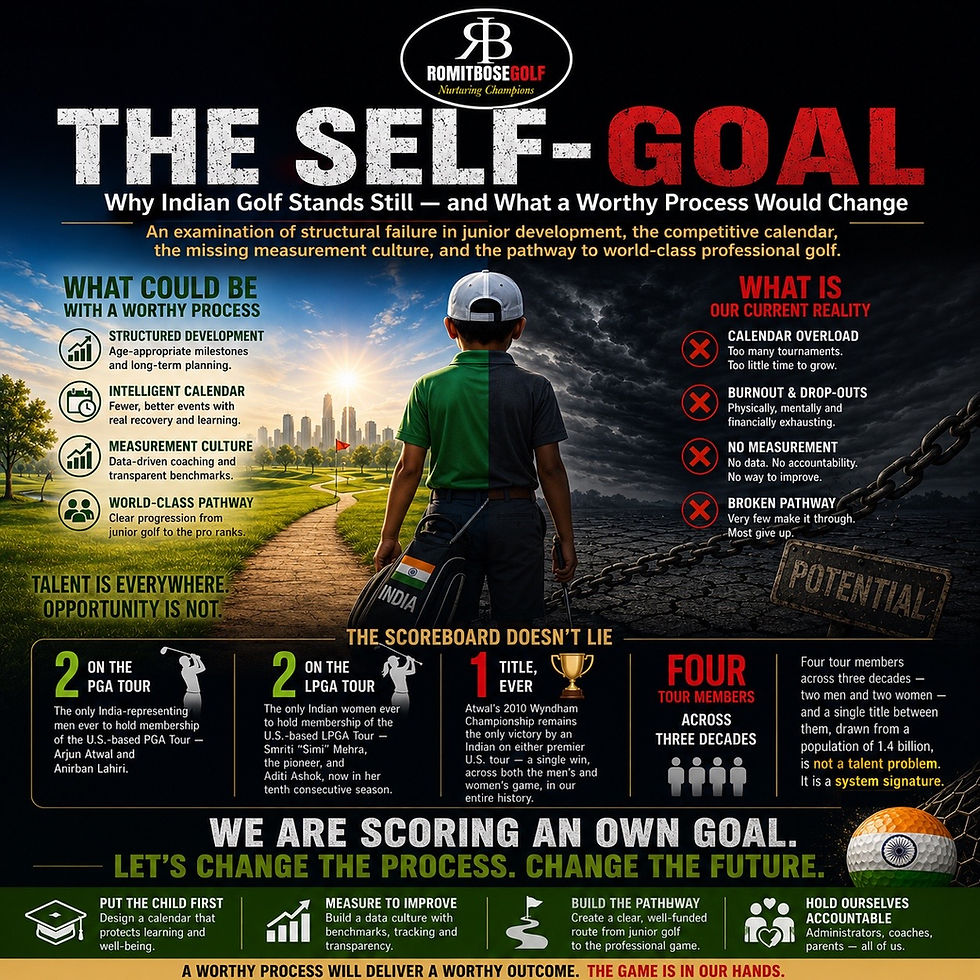
We owe our students honesty, so let us be clear: turning professional at 17 or 18 without college is a real option, and a few have made it work. Aditi Ashok and Anirban Lahiri both turned pro as teenagers and reached the very top — Olympic contention, the LPGA and the PGA & LIV Tours.

That road has genuine advantages. It offers a head start of two to four years on tour, it aims your prime physical years entirely at competition, and it avoids tuition and relocation costs if results come quickly. For the rare prodigy already beating professionals as an amateur, it can be the right call.

But the disadvantages are serious and permanent. There is no degree and no safety net if golf does not pay off. There is financial pressure from day one, because travel and coaching cost money before any prize money arrives. You develop largely alone, without a team, a system or free facilities. And burnout or injury can end everything, with nothing to fall back on.
Aditi and Lahiri are inspiring precisely because they are exceptional — each was a generational talent already competing with the world’s best. They are the exception that proves the rule.
College vs. straight to pro, at a glance
Factor | College golf pathway | Straight to professional |
Development | Coached, structured, team-driven | Self-managed and often isolated |
Competition | Year-round against elite peers | Inconsistent until you earn status |
Finances | Largely funded; NIL now allowed | You pay to play from day one |
Education | A degree you keep for life | None, unless you return later |
Risk | Low — a real safety net | High — little to fall back on |
Time to tour | Slower (about four years) | Faster, if results arrive |
Our honest verdict
Weighing both roads carefully, our position at ROMITBOSEGOLF Academy is clear: for the overwhelming majority of talented Indian juniors, the college pathway wins.
Compete with a floor beneath you, not a cliff in front of you — world-class development and a degree, so that if golf does not pay off, you still have a future.
Here is what that decision really means. College lets you compete with a floor beneath you, not a cliff in front of you. It improves your actual odds of making it, because most players who turn pro at 18 never reach a main tour, while four funded years of elite golf raise both your ceiling and your floor. And it reframes the alternative honestly: skip college only if you are already, demonstrably, beating professionals. For everyone else, patience is not the slower road. It is the faster one.
Your move
If this is the future you want, you do not have to map it alone. Begin here:
1. Get assessed. Sit down with us to map your game, your grades and a realistic timeline.
2. Compete and rank. Build a tournament schedule that grows both your record and your World Amateur Golf Ranking.
3. Prepare to qualify. Strengthen your academics and register early with the relevant eligibility centre.
4. Reach the coaches. Build your golf résumé and swing video, and let us connect you to the programmes that fit.
Play for India. Study on scholarship. Turn pro prepared.
The fairway to the world runs through the classroom — and the first step is one conversation away.
About ROMITBOSEGOLF Academy
ROMITBOSEGOLF Academy has spent more than 27 years developing junior champions in India.
To talk to our team about the college golf pathway and whether it is right for your child, get in touch with the academy.


Comments